
Could a global infrastructure boom be a boon for nature?
Ponderings on how to turn what appears to be a bag of build baby build lemons into a glass of thriving ecosystems lemonade.

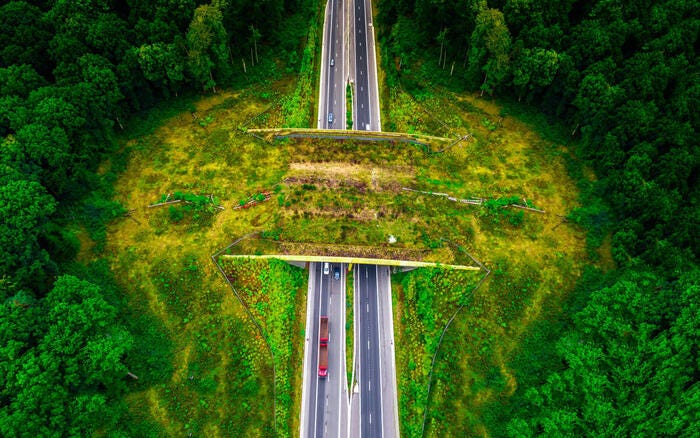
In the United States, infrastructure is a very hot topic right now. A few months ago Ezra Klein published Abundance, which calls for mass investment in housing and infrastructure and reducing the regulatory hurdles getting in the way (often environmental regulations). And you likely have seen the terms NIMBY (Not In My BackYard) and YIMBY (Yes In My BackYard) popping up in news headlines causing a stir.
With America’s aging infrastructure and lack of affordable housing, there is a growing demand to build new physical infrastructure, and this isn’t just an American trend.
Globally, across energy, transportation and mobility and digital infrastructure, Allianz estimates 3.5% of GDP or $4.2T per year is needed to replace aging infrastructure in developed economies and build new infrastructure in emerging markets.
This infrastructure requires materials, and it often requires new space. Looking back to the 70s in the US, the environmentalists playbook has traditionally focused on making sure that new infrastructure and extractive industry to provide the raw materials for that infrastructure has a minimal environmental footprint. But over the past few decades, well intentioned regulations have transformed into a regulatory review and approvals process that is no longer acceptable by the vast majority of the population. And we’re now seeing the blowback via efforts to remove all regulations instead of reforming them.
Now this isn’t an article about permitting reform, although that is also needed. This is an article about how we might be able to ride the infrastructure boom into a new paradigm for infrastructure, a paradigm where natural infrastructure is valued as much as human built grey infrastructure. Where we are not seeing the building of new physical infrastructure as a trade-off with nature, but as the driver of investment into nature - investment into nature as critical infrastructure that protects and maintains the function of human built infra.
Angle 1: Habitat/Biodiversity Net Gain
We know that new infrastructure will be built and aging infrastructure will be replaced. I think at this point, even if you think the best avenue is to try to stop it, I just don’t think that will be successful. But we can put the systems in place that make sure that if you build infrastructure that takes land away from nature, you have to protect/restore more land than you’ve removed.
Today, one of the largest sources of private capital for nature protection and restoration comes from regulations that require compensation for development. The US wetland and stream compensatory mitigation market in 2019 had annual revenues (direct economic impacts) in excess of $3.5 billion, which, along with additional indirect (supply chain) and induced (spillover) economic impacts, combine to over $9.6 billion in total output and supported over 53,000 total jobs (source).
And that is just one for one, take away an acre of wetland, you need to restore an acre of wetland with similar ecological value. I’m not going to get into the very technical discussion of what similar ecological value is, but noting that is a very important conversation.
The UK has recently gone a step further with their Biodiversity Net Gain law. BNG requires that new developments in England must deliver at least a 10% increase in biodiversity compared to the pre-development state. This means developers must demonstrate that they will leave the natural environment in a measurably better state after the project is completed. The 10% gain must be maintained for at least 30 years and can be achieved on-site, off-site, or through the purchase of biodiversity credits as a last resort.
Over 100 countries have, or are developing, policies to account for their environmental damages. If you are interested in learning more about how to make these compensation markets work, I highly recommend looking at the work coming out of Oxford University’s Nature Positive Hub and follow Sophus zu Ermgassen.
But what if we dreamed a bit more. One could envision a world in which regulation gets passed that requires more than 10% net gain. I believe the world right now is yearning for a positive vision for the future, likely a populist vision of the future. Why not require 2 for 1? Yes it might make things a bit more expensive for corporates and infrastructure investors, but on a per unit cost, I’m unsure how significant that would be. Looking to experts to put some real details/numbers to validate or disprove this hypothesis.
I actually think a regulation that requires the protection/restoration of nature relative to land used for infrastructure at a 2:1 ratio is something that could get broad bipartisan populist support.
**I want to emphasize that I firmly believe that we should continue to have a permitting system that ensures infrastructure and extractive activities for raw materials are achieving human needs while minimizing environmental impact. This optimization is critical and I hope we can reform permitting systems around the world with new technology to do this more efficiently. There are others that know this space far better than me and hopefully have some great ideas for how to achieve this reform**
So this first angle looks at how we can scale compensation and perhaps get broad political support for requiring more of it when infra is built. But what if there is another angle? We can keep compensation, but what if we also explore multiplication?
Angle 2: From Compensation to 2x Infrastructure
To be clear up front, this is a very much so me writing in riffing mode. This is a half baked idea that needs a lot more pressure testing and hypothesis proving, but see what you think.
Almost all of the infrastructure that we want to build is dependent on nature to protect it or maintain it. Data centers, nuclear energy and hydroelectric dams require dependable sources of water (at volumes that only functioning ecosystems can provide). Bridges, airports, roads and urban development needs nature to protect from flooding events, both terrestrial and on the coasts. Water utilities depend on nature to deliver cleaner water.
And beyond the infrastructure itself, other industries, like agricultural, are entirely dependent on nature for the inputs (water, nutrients) that it provides that are critical to it’s operations. Just like industry needs energy infrastructure that it pays for year in and year out, industry needs natural infrastructure to provide inputs and it probably should be paying for it, year in and year out.
Ok, so structurally how do we get to someone paying for nature as infrastructure. One avenue is to try to get nature recognized as critical infrastructure itself supporting economies as a standalone type of infrastructure. In this scenario, we essentially ride the infrastructure wave but continue to incorporate nature more and more as a type of infrastructure, sometimes green as an alternative to grey infrastructure, but also intact ecosystems being seen, valued and funded as critical national infrastructure. I’ll call this Natural Infrastructure.
The other avenue is to make the case for nature as critical to ensuring the long-term function of new human built physical infrastructure. So every time a country builds a piece of infrastructure, there’s a requirement to protect/restore ecosystems around that infra to protect/maintain it. This is a dependency/risk analysis that would be required with the build of any new infrastructure. For lack of a better term I’ll call it Nature for Built Infrastructure.
And for both of these, I think we could apply traditional infrastructure finance, where investors, likely public and private, come together to finance that Natural Infrastructure up front and beneficiaries pay fees for the services it provides. Or in the case of Nature for Built Infrastructure, a portion of the fees that ever year pay back the Built Infra investors goes to pay back the natural infrastructure that is maintaining/protecting the built infra.
It’s possible Natural Infrastructure and Nature for Built Infrastructure could end up being one and the same from the perspective of the protected/restored area, but keeping them separate because I think the finance/payment structure and source of those funds is likely different for each.
The multiplier here is if we’re gonna build infrastructure, instead of nature compensation being a cost, nature as infrastructure alongside built infrastructure is a 2x infrastructure investment. You want infrastructure, we’ll give you two times the infrastructure!
Three Angles
So after that last section, it seems to me like we are looking at three angles worth exploring to unlock more funding for nature protection and restoration linked to infrastructure.
Compensation - Scale regulatory habitat/species compensation mechanisms and work towards a higher net gain ratio making the most of the coming built infrastructure boom.
Natural Infrastructure - Get nature recognized as a unique type of critical infrastructure for economies to be resilient in the face of a changing climate. Apply traditional infrastructure finance to fund large scale protection and restoration with dependent private and public sector actors as payers for outcomes or funders.
Nature for Built Infrastructure - Regulation requiring that for all new built infrastructure, there’s a requirement to protect/restore nature around that infra to protect/maintain it.
My main message
We must change minds and systems to treat nature as critical infrastructure.
For those of you at COP30 in Brazil, how would protection and restoration of the Amazon shift if it was truly treated as critical infrastructure for the ~$3T of South American GDP that its Flying Rivers underpin.
Don’t view infrastructure as a threat to nature and environmentalism as a threat to infrastructure. Instead, let’s show that our built infrastructure and our economies will be worthless in a hundred years unless we invest in natural infrastructure at the same pace as we are investing in built infrastructure.
That’s my riff for today, as always, please give feedback, ideas, thoughts on where we can go from here.
Thanks for reading and bigger thanks for contributing to the collective brain trust with your own comments and writing!
- Eric
Eric – I could not agree more.
We did the math on biodiversity compensation for infrastructure development in the Financing Nature report a few years ago. https://www.paulsoninstitute.org/wp-content/uploads/2020/09/FINANCING-NATURE_Full-Report_Final-Version_091520.pdf
We estimated that properly applying the mitigation hierarchy (as spelled out in the UN Biodiversity Convention Decision 14.3) to the anticipated infrastructure build out to meet the SDGs and the Paris Agreement goals should result in something like a required compensation payment of $160 billion per year.
Investing in Natural infrastructure could generate another $100+ billion per year.
Collectively, these are some of the biggest pieces of the puzzle to closing the biodiversity finance gap.